
For a regular Muni fare, you can ride a 1920s streetcar from Milan or a PCC car from Philadelphia down Market Street and along the Embarcadero to Fisherman's Wharf. The F Market & Wharves line is one of the few places in the country where vintage streetcars run as everyday public transit. It took more than a decade of lobbying to get there.
The subway that cleared Market Street
According to the SFMTA, the 1962 bond measure that created BART also paid for a subway under Market Street, with BART on the lower level and Muni Metro above it. Muni Metro service began underground on the N line in February 1980, and by November 1982 all the streetcar lines were running in the tunnel. That left the surface tracks on Market Street with no regular service.
Proposals to run historic cars on Market Street date to 1971, and on the Embarcadero to 1974. The idea got a push in 1979, when Muni operator Maurice Klebolt brought Hamburg streetcar No. 3557 to San Francisco to promote a historic line.
The Trolley Festival
Weekend historic service ran on Market Street in 1981 and 1982. Then in 1983, while the cable cars were shut for a rebuild, the city held a Trolley Festival with vintage cars to give visitors something to ride. It was popular enough to return each summer through 1987.
Full-time F-line service began on Sept. 1, 1995, with a parade of PCC cars painted to represent North American transit systems. Fourteen of those cars came second-hand from Philadelphia. Later, ten 1920s Peter Witt-style cars were acquired from Milan. The line was extended along the Embarcadero to Fisherman's Wharf in March 2000. It runs about 20 hours a day and charges regular Muni fares. The nonprofit Market Street Railway works with Muni to restore and promote the cars.
The name has older roots. An earlier F-Stockton streetcar route ran from 1915 to 1951.
Riding it
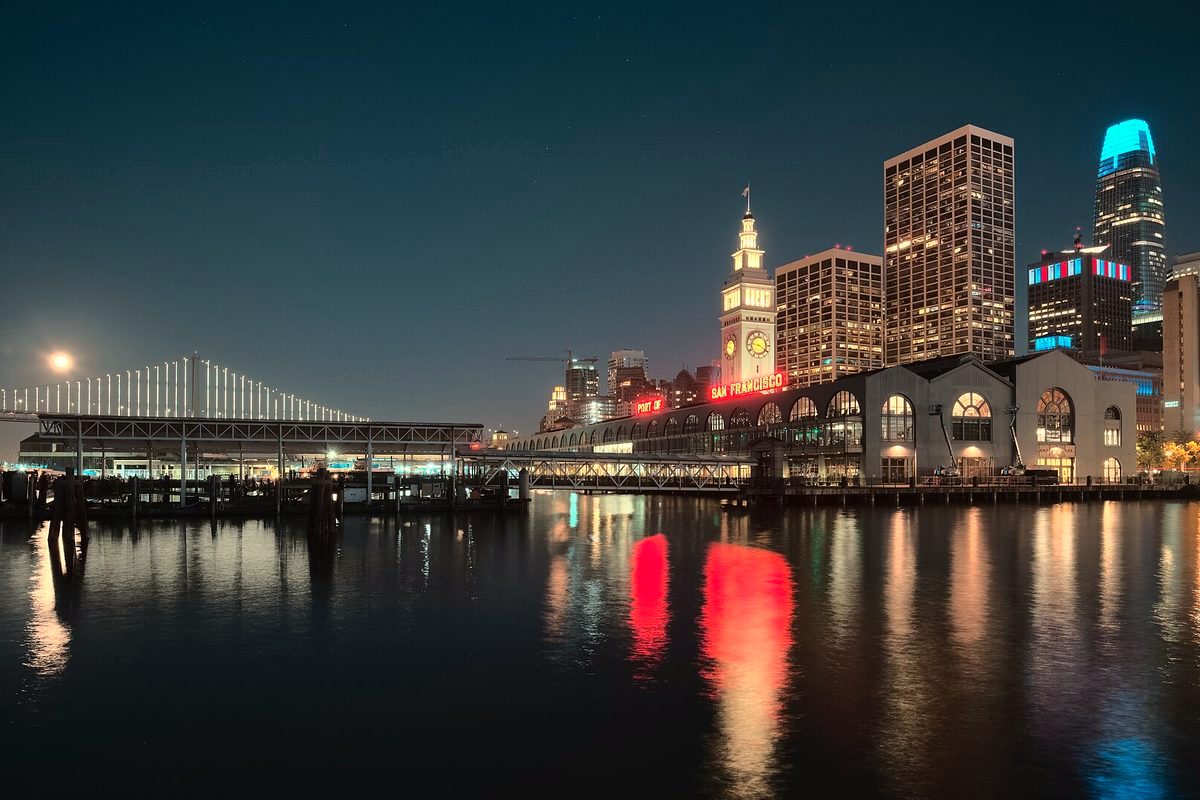
The line runs from the Castro down Market Street to the Ferry Building, then along the Embarcadero to its terminal near Jones Street at Fisherman's Wharf. Unlike the cable cars, it charges the regular Muni fare. Because the fleet mixes cars from different cities and decades, you rarely ride the same kind of car twice.