
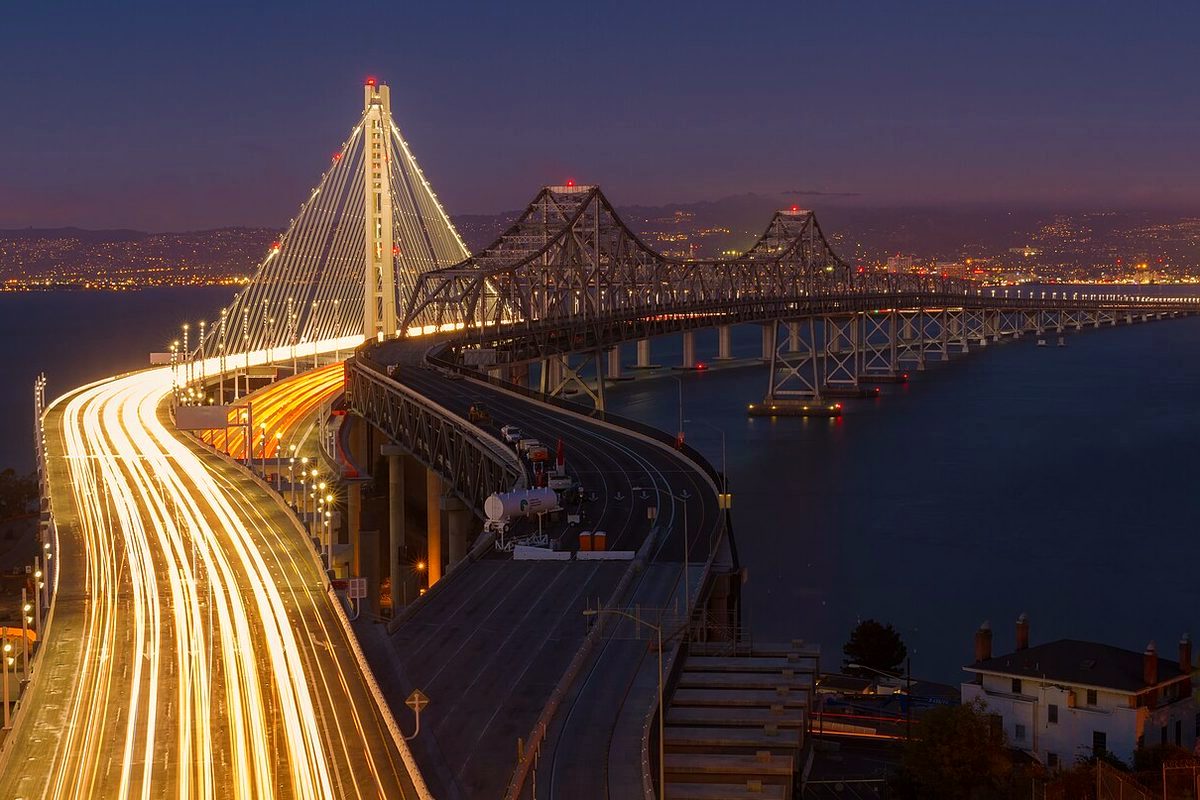
Long before BART, East Bay commuters got to San Francisco on orange trains that ran out a long pier to the ferries, and later across the Bay Bridge. That was the Key System.
Borax Smith's railway
The system grew out of streetcar lines that Francis Marion "Borax" Smith put together in the late 1890s and early 1900s, after he made his fortune in borax. It was incorporated in 1902 as the San Francisco, Oakland and San Jose Railway. Transbay service started on Oct. 26, 1903, when a four-car train carried 250 passengers from downtown Berkeley to the ferry. General manager Frank C. Havens came up with a stylized map in which the routes looked like an old-fashioned key. Loops through Berkeley, Piedmont and Oakland formed the handle, the pier was the shaft, and the ferry berths were the teeth. The name stuck.
At its height
The Key System served Oakland, Berkeley, Alameda, Emeryville, Piedmont, San Leandro, Richmond, Albany and El Cerrito. By the 1940s it had more than 66 miles of track. During World War II it built and ran the Shipyard Railway to the Kaiser shipyards in Richmond. The company went through bankruptcy in 1923 and several name changes, and only became simply "the Key System" in 1938.
The end, and what replaced it
Local streetcars stopped in 1948, and the transbay commuter trains ended in 1958. AC Transit's history page says East Bay voters created the Alameda-Contra Costa Transit District in November 1956. A $16.5 million bond approved in 1959 let the new district buy the bankrupt Key System from the California Public Utilities Commission in 1960. Today BART and AC Transit cover the old Key System territory. AC Transit traces its own family tree back to an 1869 horse-drawn rail car on Broadway in Oakland.