
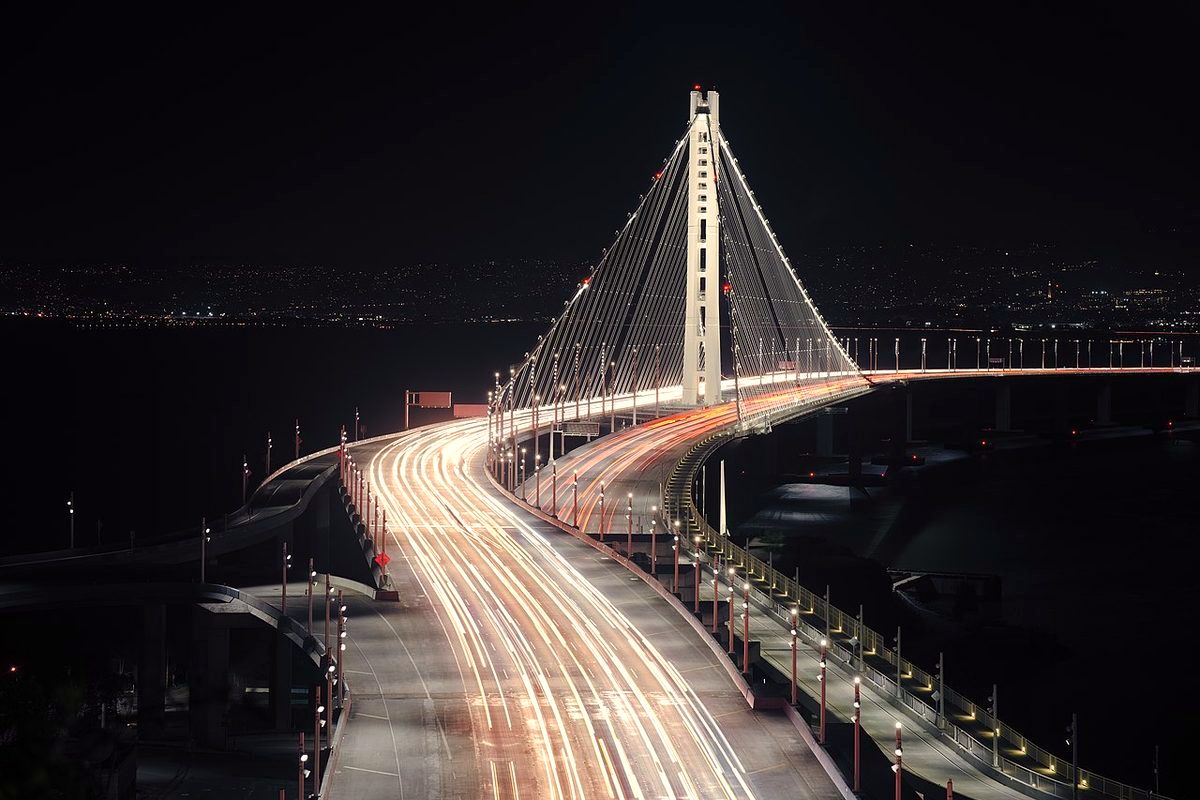
The San Francisco–Oakland Bay Bridge opened to traffic on Nov. 12, 1936, so it turns 90 on Thursday, Nov. 12, 2026. Caltrans calls the opening "a remarkable engineering and political achievement." The Metropolitan Transportation Commission (MTC) calls the bridge the region's "workhorse."
An idea from the Gold Rush era
People proposed a bridge across the bay as early as the Gold Rush. In 1872, San Francisco's self-proclaimed Emperor Norton issued three decrees ordering a suspension bridge between Oakland and San Francisco. The engineering and cost were beyond the era, and construction didn't begin until July 9, 1933. That day, President Franklin D. Roosevelt remotely set off a dynamite blast on Yerba Buena Island, and former President Herbert Hoover helped turn the first earth.
Who built it
The Federal Highway Administration's history says California passed legislation in 1929 creating the California Toll Bridge Authority. Charles H. Purcell, the State Highway Engineer, prepared the report of the bridge commission that followed and became the Bay Bridge's chief engineer in August 1931. The bridge opened about six months before the Golden Gate Bridge. MTC lists the 1936 structure's cost as $77 million, including the Transbay Transit Terminal.
Trains on the lower deck
The bridge originally carried cars on the upper deck. Trucks, buses and Key System commuter trains used the lower deck. After the Key System ended rail service on April 20, 1958, the lower deck was converted to road traffic. On Oct. 12, 1963, the bridge switched to its current setup: westbound traffic on the upper deck and eastbound on the lower.
Earthquake and a new East Span
The 1989 Loma Prieta earthquake damaged the original East Span, which was then repaired. The replacement East Span, a single-tower self-anchored suspension bridge with a skyway, opened Sept. 2, 2013, at a cost of $6.4 billion, according to MTC. Seismic retrofit of the West Span was finished in 2004. The East Span also carries the Bay Bridge Trail for people biking and walking between Oakland and Yerba Buena Island.
The bridge by the numbers
- Length: 8.4 miles including approaches and toll plaza (MTC)
- Lanes: five in each direction
- Toll-paying vehicles: 42.75 million in fiscal 2022-23
- Car toll: $8.50, collected westbound only
- The Bay Lights 360, 50,000 LEDs designed by Leo Villareal, began nightly on March 20, 2026.
Emperor Norton, again
For the 90th anniversary, the Emperor Norton Trust proposed naming the Yerba Buena Island tunnel the "Emperor Norton Tunnel." State Sen. Scott Wiener carried it as Senate Concurrent Resolution 193 in August 2026. The resolution got no Assembly committee or floor votes before the session ended, and the trust says it wants it reintroduced in the 2027–28 session, according to Wikipedia's account.
More Bay Area history: the 1989 Loma Prieta earthquake.