
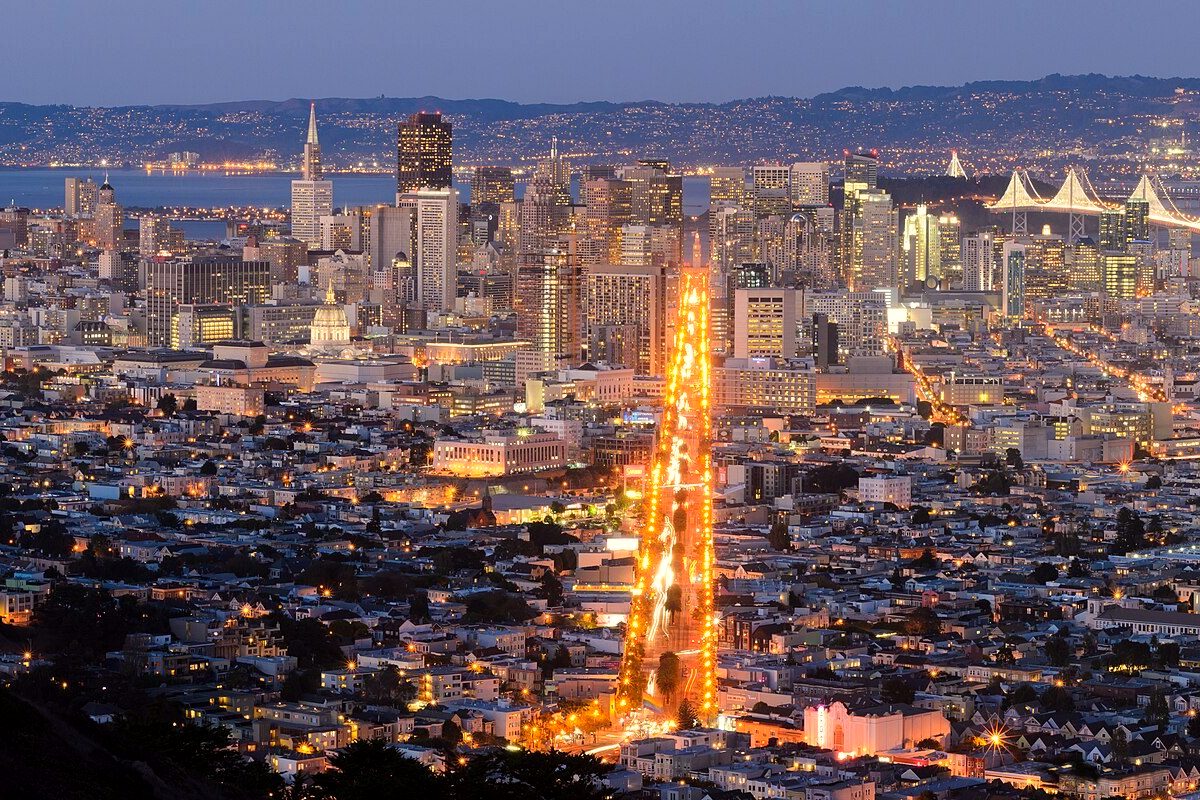
Bernal Hill gives visitors a 360-degree panorama of San Francisco Bay, the Golden Gate Bridge, downtown, San Bruno Mountain and the East Bay hills. San Francisco Recreation and Parks says its windswept slopes are often still sunny when Twin Peaks is wrapped in afternoon fog. Wikipedia says the upper hill is part of the 26.3-acre Bernal Heights Park, almost entirely ringed by Bernal Heights Boulevard.
Getting around
A paved, limited-access road and a network of dirt trails circle the hill and lead to the summit. The department lists an accessible children's play area, a natural area and an off-leash dog play area. At the top, 466 feet up, Wikipedia says there's a privately owned equipment building and a 50-foot telecom tower that some neighbors call "Sutrito" because it looks like a small Sutro Tower.
Wildflowers and wildlife
In summer and fall the grass is dry and tawny. By early February, the department says, the hill turns colorful with native wildflowers including footsteps of spring, sun cup, blue-eyed grass, checkerbloom and shooting star. More than 40 bird species use the hill, among them Anna's hummingbirds, American kestrels, western meadowlarks and Townsend's warblers. Alligator lizards and gopher snakes bask on the rocks.
Coyotes have come back, and Wikipedia says Bernal was one of the first San Francisco hills to be recolonized by them. The department asks visitors not to approach or feed them ("a fed coyote is a dead coyote") and to keep dogs leashed where coyotes are known to be around.
History
According to the department, the hill was part of a 4,446-acre land grant to José Cornelio de Bernal, a soldier on Juan Bautista de Anza's 1776 expedition. In May 1876, Frenchman Victor Resayre claimed to have found gold on the summit worth $1 million a ton. Days of digging followed before the "ore" turned out to be quartz. The hill's stable rock spared most Bernal Heights homes in the 1906 earthquake.
Wikipedia says the summit's red rock is radiolarian chert, a sedimentary rock built from the silica shells of microscopic radiolaria and colored by iron oxide.
Restoration began in 1973, when residents Barbara and Roland Pitschel started organizing volunteer projects. In 1980 the group received city approval for grassland habitat restoration, which the department calls the first project of its kind in San Francisco.
For another hilltop view: the story of Sutro Tower.